DeltaChess: a chess engine rabbit hole inside World of Warcraft
It started as a dumb bet with a guildmate: “Can you write a fully handwritten chess program in under 7 hours?”
Seven hours later I had something that kind of moved pieces around — a tiny Python console program that could draw a board and accept moves. Nothing fancy. No UI. No clocks. Barely any rules. But it was mine, and it worked enough to be fun.
Then another friend said the sentence that doomed my free time:
“Okay… but what if this was a World of Warcraft addon?”
And that idea was too good to ignore. So I started over — different language, different constraints, different everything. The result is DeltaChess: chess inside WoW, against other players (including cross‑realm where WoW allows) or against the computer.
If you want to peek at it later: CurseForge / GitHub
Chess in a place that really doesn’t want chess
Writing chess code is one thing. Writing chess code in the WoW Lua sandbox is another.
In Python on the console, “just compute for a bit longer” is an acceptable strategy. In WoW, it’s a great way to make the game hitch and drop frames. So the project quickly became about constraints:
- Rules correctness: castling, en passant, promotion, draw rules… the boring parts that make it “real chess”.
- Responsiveness: engines must yield work so the game keeps rendering smoothly.
- Determinism and safety: don’t crash your UI because an engine tried something illegal.
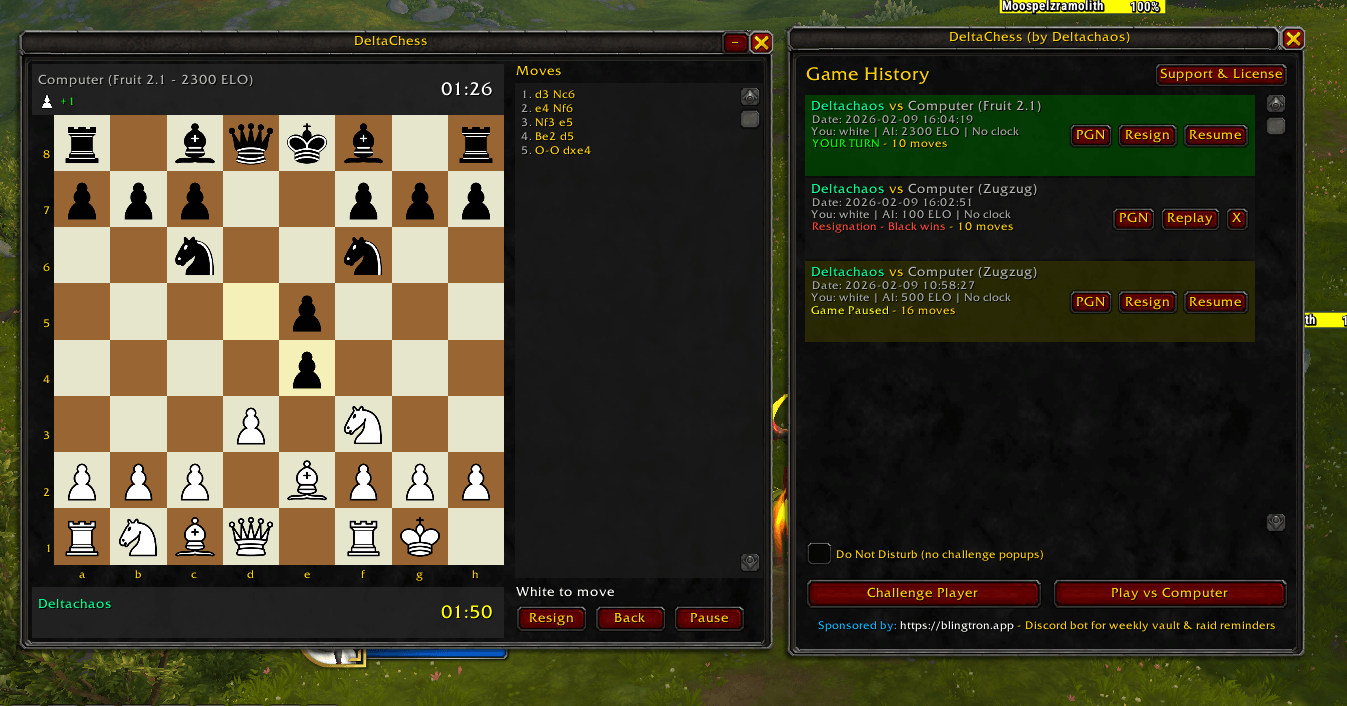
Here’s what the board looks like today:
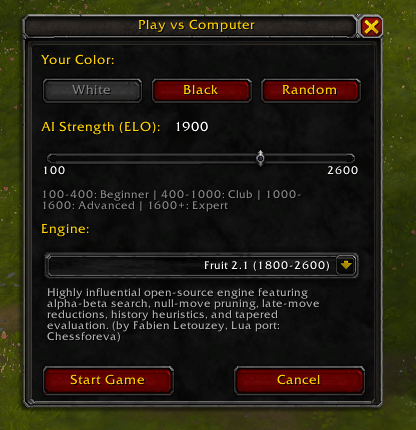
And the “play vs computer” flow that wires the UI into the engine framework:
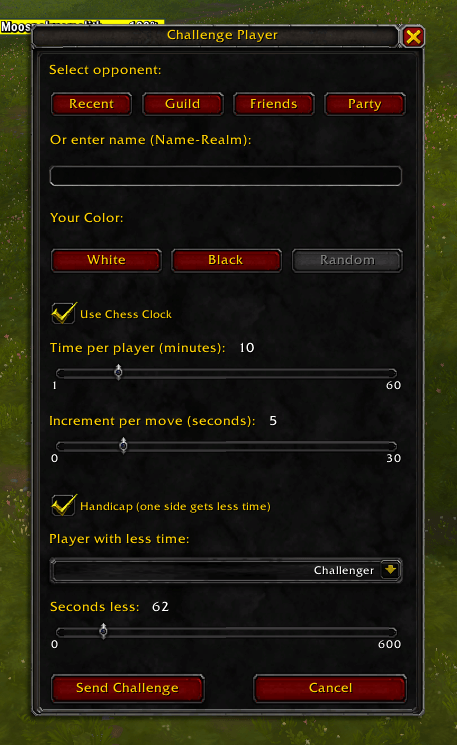
PGN export was a must-have (because what’s the point of blundering in WoW if you can’t paste it into Lichess later?):
The part I didn’t expect: I actually learned chess programming
I used a fair amount of AI assistance for UI and addon glue code, but the engine side pulled me into the classic chess programming rabbit hole: search, evaluation tradeoffs, move generation pitfalls, and performance tricks you only learn once you can feel the branching factor.
Some highlights of what I ended up (re-)learning:
- UCI (Universal Chess Interface): the lingua franca for “engine talks to GUI”. I built a small UCI wrapper so I could run and test the Lua engines from the outside world (and compare behaviors).
- Minimax → Negamax: switching from “two-player min/max” to “one function + sign flip” is one of those “why didn’t I do this earlier?” moments.
- Alpha–Beta pruning: the first time you watch node counts collapse because your move ordering improved, it’s addictive.
And on a purely personal level: it was a nice excuse to refresh my Lua knowledge (including the parts you only remember once you write something non-trivial and performance-sensitive).
A pluggable, async engine framework (because WoW demands it)
DeltaChess ships with a small engine framework that tries to make the hard parts boring:
- Engines are stateless: each calculation gets a position + options; no hidden global state required.
- The runner is single-threaded and async: engines can yield via a callback so computations spread across frames.
- Every move is validated: if an engine returns an illegal move, it’s caught immediately.
The real reason the framework exists: testing outside of WoW
One of the biggest practical problems early on wasn’t even search or evaluation — it was testing.
Inside WoW I couldn’t easily run automated tests that would tell me whether an engine always produces legal moves, and whether the move generator behaves consistently across thousands of positions. Debugging that kind of thing by hand, in a UI, is misery.
So I extracted the whole “business logic” (rules + move generation) and the engines into a separate project that can run completely outside the WoW environment. That gave me a proper automated test suite where engines can self-play and every returned move is validated for legality.
The framework also supports ELO-based difficulty selection and ships with four engines spanning roughly beginner to very strong:
| Engine | Notes |
|---|---|
| Dumb Goblin | “Capture the highest thing” style — great for absolute beginners |
| Sunfish | MTD-bi + iterative deepening + transposition tables |
| GarboChess | Alpha–beta with classic pruning/ordering heuristics (null move, killers, SEE, …) |
| Fruit 2.1 | A historically influential engine with a bag of serious search tricks (LMR, history heuristics, tapered eval, …) |
Huge thanks to Chessforeva and their Lua chess work, especially the Lua4chess
repository. They had already ported several classic engines to Lua, which made them way easier to integrate.
There was one catch though: those ports were written in a more “normal” style where you just… calculate until you’re done. In WoW’s single-threaded UI, that meant the game could hang for several seconds whenever an engine thought too long.
So a big chunk of the project ended up being rewriting/adapting the engines to allow async execution in an event loop: do some work, yield, resume next frame, repeat — so the game stays responsive while the engine is searching.
If you’re curious, the engine framework lives here: deltachess-engine-framework
Where I’m stuck: ELO calibration for slow Lua engines
This is the part where I’d love advice from people who have done this “for real”.
The engines are written in Lua (because WoW), so they’re slow compared to typical C/C++ engines. I tried running tournaments via cutechess, but getting anything remotely stable takes an absurd amount of time.
My goal isn’t perfect scientific accuracy—I just want players to pick an AI opponent that roughly matches their strength, instead of random “difficulty” labels.
So if you have experience with engine testing and rating, I’d appreciate any pointers:
- Are there smarter ways to estimate / approximate ELO for slow engines without weeks of round-robin games?
- Any good approaches for calibrating across very different environments (fast desktop vs WoW sandbox)?
- Any tricks for cutting down match counts without totally ruining the numbers (SPR T-tests, sequential testing, smarter opponent selection, etc.)?
If you try DeltaChess, skim the code, or have “don’t do this, it’s a bad idea” comments—please let me know. This was never meant to be a serious engine project, but it definitely pushed me down the rabbit hole, and I’d love to learn more.